Nutrient Management is a sustainable approach to delivering the right nutrients, at the right rate, at the right time, and to the right place, to maximize economic benefits while minimizing environmental impact.
By following the 4Rs, producers improve crop productivity, increase nutrient use efficiency by the plant, and protect downstream surface water sources, aquifers, and air quality.
Strategic Factors to Consider When Developing a Nutrient Management Plan
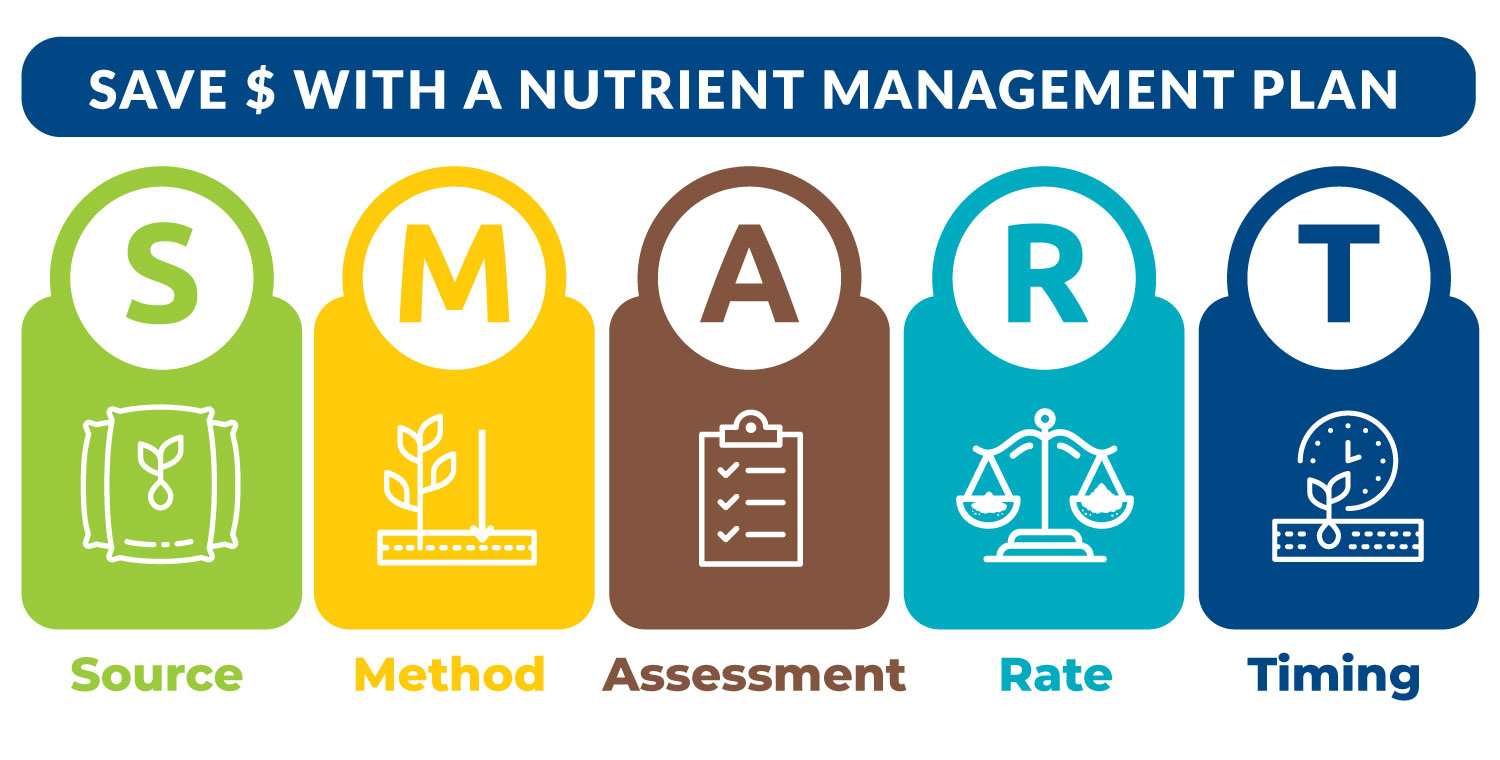
A SMART Nutrient Management Plan includes the 4Rs of nutrient stewardship (the right Source, right Rate, right Time, and right Place) and emphasizes smart activities to reduce nutrient loss by Assessment of comprehensive, site-specific conditions.
A nutrient management plan should be Site-specific, with Measurable nutrient sources and soil fertility, with an Achievable nutrient budget, Realistic crop yields and nutrient application rates, and crop nutrient needs align with Timely nutrient applications guided by the local climate and the crop's stage of growth.

Assessment
Preplanning is not just an important component of developing a nutrient management plan but also as part of implementing the plan. When determining the nutrient source, rate, place, and timing of an application that best fits the operation, site-specific conditions of your land and operation will need to be assessed.
- Preplanning. Use the Site Risk for Water Quality (SRWQ) or an approved tool in preplanning to identify potential nutrient loss pathways.
- Risk Assessment. A certified nutrient management planner (technical service providers (TSPs) and NRCS planners) will analyze your site-specific land conditions, perform an NRCS-approved risk assessment, and draft a nutrient management plan tailored to your land.
- Testing. Testing and analysis can tell you what nutrients are already present in the soil or plant, and organic matter levels to determine what nutrients are needed.
- Current or planned conservation practices. Conservation practices such as cover crops, no-till, or conservation tillage should be assessed to determine how they might affect nutrient requirements and reduce nutrient losses.
Source
Producers generally apply commercial fertilizers, animal manures, or organic-by-products to meet plant nutrient needs. When determining the nutrient source that best fits the operation, consider:
- Best match. Choose nutrient sources to best match crop and soil needs while minimizing the site-specific risk of nutrient loss. Needs vary depending on your local soil and climate conditions, specific crop, animals, and conservation practices you implement such as reduced tillage, no-till, or cover crops.
- Utilization needs. Select nutrients based on crop utilization needs. New plantings may benefit from delayed nutrient release patterns for release after seed germination, while established crops will be ready to take up nutrients immediately.
- Testing. Testing manure, soil amendments, and organic by-products for nutrient content before application can help meet crop nutrient needs more efficiently, decrease risk of pollution, and increase profit.
Rate
Applying nutrients at the right rate ensures crops get what they need, limiting excess nutrients that can be lost to the environment. Many factors affect crop nutrient needs. When determining the rate of application, consider:
- Testing. Soil and plant test results will let you know what nutrients are needed and how much you should apply given the specific source of nutrients being used.
- Crop need. Base nutrient application rates on realistic yield goals, crop nutrient uptake requirements, and soil test recommendations following LGU guidance.
- Soil health practices. Conservation practices that naturally increase soil organic matter and enhance biological processes may reduce fertilizer needs.
- Technology. Precision technologies such as global positioning systems (GPS) guidance and variable rate applications can improve nutrient use efficiency by delivering the needed nutrient amounts according to historic yields and soil-test nutrient levels.
Time
Appropriately timing the application of nutrients is critical. When determining when to apply nutrients, consider:
- Crop demand. Nutrients should be applied when crops need them most to maximize uptake and effectiveness. Split-applying nitrogen, for instance, delivers nutrients at targeted times during the growing season.
- Weather and seasonal conditions. Fertilizer applications immediately before a large rainfall could contribute to nutrient losses.
- Technology. Technologies such as precision guidance systems allow producers to precisely apply nutrients to actively growing crops.
Place
For effective nutrient management, placement and method of application can make all the difference. When determining how and where to apply nutrients, consider:
- Injection. Placing nutrients below the soil surface and into the crop root zone increases the plant's ability to access them, reducing loss to air and water.
- Incorporation. Specific sites may require incorporating nutrients into the soil, rather than broadcasting on the soil surface to reduce the risk of nutrient loss during runoff events. If surface nutrient application is necessary, light incorporation of manure or fertilizer after application can help reduce potential losses.
- Combined practices. When nutrient incorporation or injection are not practical, combine in-field conservation practices (such as cover crops or residue management) with edge-of-field (such as buffers or filter strips) practices to reduce nutrient losses.
- GPS and precision technologies. Use technologies such as global positioning systems (GPS) guidance and variable rate technology (VRT) to match the right nutrient rate, in the right place to meet the specific needs of different parts of the field.
Assessment – Again!
To ensure that your nutrient management plan is SMART, you can reassess within a crop growing season or at the end of each crop rotation.
- Testing. If your nutrient source changes, you should test the new source for available nutrients to best match the needs of your crop while considering already available nutrients in the soil.
- Change. If the number of animals changes, crops in the rotation changes, or source of nutrients change, work with your technical service provider or NRCS planner to update your nutrient management plan.
More Information
- Farmers.gov Blog: Save Money and Protect Water Quality with SMART Nutrient Management
- Infographic: SMART Nutrient Management
- Fact Sheet: Economic Benefits from Implementation of Practice 590 — Nutrient Management on Acres with Excessive Nutrient Loss
- Press Release: USDA Announces New Opportunities to Improve Nutrient Management
- Farmers.gov: Helping Farmers Address Global Food Insecurity
- Farmers.gov: How to Get Started with Nutrient Management
- USDA Report: Conservation Practices on Cultivated Cropland A Comparison of CEAP I and CEAP II Survey Data and Modeling
- NRCS Conservation Outcomes Webinar: Achieving Water Quality Outcomes Through Nutrient and Water Management, NRCS Conservation Outcomes - YouTube
- NRCS Conservation Outcomes Webinar: Ask the Expert: A Q&A on Water Quality Outcomes of Voluntary Conservation with Lisa Duriancik
- Conservation Webinar Portal: https://www.conservationwebinars.net