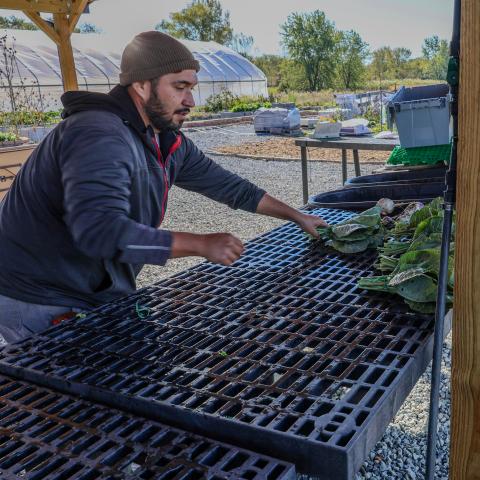
Are you gardening or farming in a small-scale environment? NRCS has resources that can help you start and grow your operation.

NRCS can help
Natural Resources Conservation Service (NRCS) offers technical and financial assistance with conservation practices, such as high tunnels, and we can help you develop a conservation plan.
Small-Scale Agriculture
No matter the size of your farm or ranch, NRCS offers assistance with conservation planning and installing practices that are specific to your natural resource needs and business goals.
From simple management systems, such as planting cover crops, to complex structural practices, such as animal waste management systems or innovative irrigation devices, NRCS has a conservation solution for you.
Service Centers
If you haven’t worked with USDA previously, your first step should be to contact your USDA Service Center and make an appointment. Find your nearest office by using the tool below. Be sure to ask what documents you’ll need.
Some considerations before your visit:
What is your vision for your garden or farm?
What are your challenges?
If you need information in a language other than English, we offer free translation services.
Chicago Area Contact
If you are in the Chicago area, contact our District Conservationist, Joseph Bridges.
Illinois Successes
Visit our Illinois Success Story to find out more about It Takes a Village and how you can improve your operation with NRCS just like they did!
Other resources
Publications
Visit Solutions for Small-Scale Farms for fact sheets or click the links below:
- Abandoned Well Plugging: a plugged well is no longer dangerous as an open hole to people, animals, and farm machinery.
- Ag Chemical Handling Facility: A farm chemical mixing or handling area is a place where chemicals are mixed or a field sprayer is filled so that any spills do not soak into the ground.
- Alley Cropping: Plant crops between tree rows to generate annual income and diversify your operation.
- Animal Mortality Disposal: An animal mortality disposal facility is a safe method to dispose of dead livestock. Typical methods include composting, incineration, rendering, and burial.
- Balancing Animals with Forage: Increase pasture longevity by understanding your forage-animal balance.
- Biological Pest Management: Better control insects and disease with natural alternatives for your lands and structures.
- Composting Manure: Composting is well suited for manure that contains a lot of bedding material, such as straw, sawdust, wood shavings, or spilled hay.
- Cover Crops: Utilize planting grasses and legumes to combat crusting soils, soil erosion, weeds and more.
- Farmstead Windbreaks: Reduce heating cost and provide a natural barrier for weather events and debris.
- Fencing: Better manage and protect your resources by strategically limiting access from animals and people.
- Forage Planting: Provide weed management, increase livestock feed, poor yields and lack of legumes.
- Forest Farming: Diversify your land and make your land more profitable.
- Fuel and Fire Breaks: Increase protection of your property and resources from the hazards of wildfire.
- Grade Stabilization: Grade stabilization is installed to stop a gully at the edge of a field. It is usually installed with a grassed waterway that brings water to the structure.
- Heavy Use Area Protection: A heavy use area is protected by first removing all the mud and muck, then replacing it with something that will last for a long time such as gravel or clam shells.
- Irrigation Water Management: Irrigation water management is a plan to help you know when, how much, and at what rate to apply irrigation water in an efficient manner.
- Low-Cost Irrigation System: A low-cost irrigation system can be as simple as a series of troughs or gutters moving water by gravity.
- Managing Manure Nutrients - Central: Managing nutrients in manure means taking advantage of the nutrients, so you buy less fertilizer and improve soil and water quality.
- Managing Manure Nutrients - East: Managing nutrients in manure means taking advantage of the nutrients, so you buy less fertilizer and improve soil and water quality.
- Managing Natural Vegetation - Early Successional Habitat Management: “Early successional” plants are those that first grow on an area following a disturbance, such as a fire. Managing these plants that grow naturally on your farm can provide habitat for common wildlife species such as deer, rabbits, quail, turkey, doves, and songbirds.
- Manure Storage: Storage makes it easier to get manure in the right place at the right time to improve the quality of your soil and the health of your crops.
- Native Pollinators: Improve crop production and quality with the help of native pollinators.
- Odor Control: Reduce unwanted smell or manure visibility of livestock operations.
- Pruning: Remove tree overgrowth to decrease fire hazard and increase production of vegetation.
- Rotations for Livestock Feed: Implement crop rotations to address livestock feed needs and reduce costs.
- Rotations for Soil Fertility: Implement crop rotations to address soil issues and improve crop yields.
- Runoff Management: Helps reduce water running off land around a livestock farm that can be polluted with manure and mud impacting streams and lakes.
- Selecting an Irrigation System: It is very important that increased yield and better crop quality will result in sufficient increase in income to offset the cost of installing and operating the irrigation system.
- Silvopasture: Take advantage of tree, forage and livestock production on the same acreage at the same time.
- Small Woodlot Improvement: Address overcrowded woodlands to reduce wildfire risk and improve productivity.
- Soil Health: Increase plant health and decrease soil issues like erosion and runoff.
- Soil Testing: Identify production problems related to nutrient deficiencies or imbalances.
- Sources of Water: Before you buy and install an irrigation system you must find a source of water and determine the rate (quantity) and quality of the water.
- Spring Development: Even a small spring flowing all the time can provide a lot of water.
- Stream Crossing: A stream crossing provides a hard, stable area where livestock or equipment can cross a stream without damaging the streambed or banks.
- Vegetative Barrier: Utilize perennial plants to address gully erosion in fields.
- Watering Facility: A watering facility can be a permanent or portable watering trough or a device like a nose pump that lets cows pump water from a stream or pond.
Websites
Illinois Urban Manual
A technical manual designed for urban ecosystem protection and enhancement. Contains standards, construction specifications, material specifications and standard drawings.

Illinois Projects